Reverse Mortgage Options for BC, Alberta, Ontario and Saskatchewan Homeowners 55+
Access a Portion of Your Home Equity
Access a portion of your home equity without selling your home or making required monthly principal and interest payments.
Cutting Edge Lending helps eligible homeowners in Western Canada and Ontario explore available Canadian reverse mortgage options. We explain how the process works, what it may cost, and how it compares with alternatives so you can make an informed decision.
Get an initial estimate with no obligation to proceed.
Put Your Home Equity to Work While Staying in the Home You Love
If you’re 55 or older and own a home in British Columbia, Alberta, Ontario or Saskatchewan a reverse mortgage may allow you to convert part of your home equity into borrowed funds that are generally not treated as taxable income, while continuing to live in your home.
Funds may be used for many purposes, including:
- Supplementing retirement cash flow.
- Paying out an existing mortgage or other secured debt.
- Funding home renovations or accessibility upgrades.
- Covering healthcare or other major expenses.
- Helping family members.
- Creating flexibility for planned or unexpected costs.
Funds may be advanced as a lump sum, regular advances, or another structure, depending on the lender and approved product.
Cutting Edge Lending helps you compare available reverse mortgage options from Canadian lenders. We explain rates, fees, repayment terms, potential drawbacks, and alternatives in plain language so you can make an informed decision without pressure.
Do you have questions? Contact us today.
Who Qualifies for a Reverse Mortgage?
While every lender has its own guidelines, you may qualify for a reverse mortgage if:
- You are 55 years of age or older.
- You own an eligible residential property in Canada.
- Your property is in British Columbia, Alberta, Ontario or Saskatchewan
- The home is your principal residence.
- You have sufficient equity in the property.
- The property meets the lender’s location and marketability requirements.
Eligible property types may include:
- Detached homes.
- Townhomes.
- Condominiums.
- Duplexes or similar residential properties.
- Certain rural properties.
Property eligibility always depends on the lender.
What If You Still Have a Mortgage?
Having an existing mortgage doesn’t necessarily prevent you from qualifying.
Many homeowners use part of the reverse mortgage proceeds to pay out an existing mortgage or another debt secured against the home. Whether this is possible depends on the amount you qualify for and the balance that needs to be repaid.
The approved reverse mortgage must generally be sufficient to pay out the existing mortgage and other secured debts while also meeting the lender’s requirements. Approval is not automatic.
How Our Reverse Mortgage Process Works
Getting a reverse mortgage doesn’t need to feel complicated. We guide you from your first questions through to funding.
1. Check Your Eligibility
We start by reviewing the basics of your situation, including:
- Your age.
- Your spouse or co-owner’s age, if applicable.
- Property type.
- Property location.
- Estimated home value.
- Current mortgage balance.
- Other debt secured against the property.
Reverse mortgages are generally designed for Canadian homeowners aged 55 or older who live in the property as their principal residence. At least one borrower is typically 55 or older; a spouse or co-owner’s age can affect the amount available and how the application is structured.
Final eligibility depends on the lender, the property, and the details of your application.
2. Get a Custom Estimate
Next, we provide an initial estimate of how much home equity you may be able to access.
The amount available can depend on:
- Your age.
- The age of your spouse or co-owner.
- Property location.
- Property type.
- Appraised market value.
- Property condition.
- Current lender guidelines.
- Existing mortgages or secured debts that need to be paid out.
This is an initial estimate only and does not guarantee approval. The final amount, rate, fees, and terms are determined by the lender after reviewing the application, property, appraisal, and supporting documents.
3. Application & Appraisal
If you decide to move forward, we help prepare your application and coordinate the required documentation.
Most reverse mortgage lenders require a professional appraisal to confirm the market value of the property. We help coordinate the process, communicate with the lender, and keep you informed along the way.
4. Independent Legal Advice
Independent legal advice may be required before closing, depending on the lender and product.
Before closing, you’ll meet with a lawyer or notary, as applicable, who acts independently from the lender and brokerage. They will review the mortgage documents with you and make sure you understand the terms, costs, obligations, and repayment conditions before you sign.
5. Closing and Funding
Once all lender conditions are satisfied and the mortgage closes, the funds are advanced according to the approved structure.
Unlike a traditional mortgage, you generally don’t need to make regular monthly principal and interest payments. Instead, interest is added to the mortgage balance over time.
The loan is typically repaid when:
- The home is sold.
- You permanently move out.
- The last borrower dies.
- A repayment condition or default occurs under the mortgage agreement.
How Much Equity Can You Access?
There isn’t one standard reverse mortgage amount for every homeowner.
Your borrowing limit depends on factors such as:
- Your age.
- Your spouse or co-owner’s age.
- The location of your home.
- Property type.
- Property condition.
- Appraised property value.
- The lender and reverse mortgage product.
- Existing mortgage balances or secured debt.
Depending on your age, property, location, lender, and existing secured debt, you may be able to access up to approximately 55% of the appraised value of the home in certain circumstances.
Your actual limit may be lower and is determined by the lender.
Reverse Mortgage Costs, Risks & What You Should Know
A reverse mortgage can improve cash flow and provide access to home equity, but it isn’t free money. Understanding the long-term cost is one of the most important parts of deciding whether a reverse mortgage is right for you.
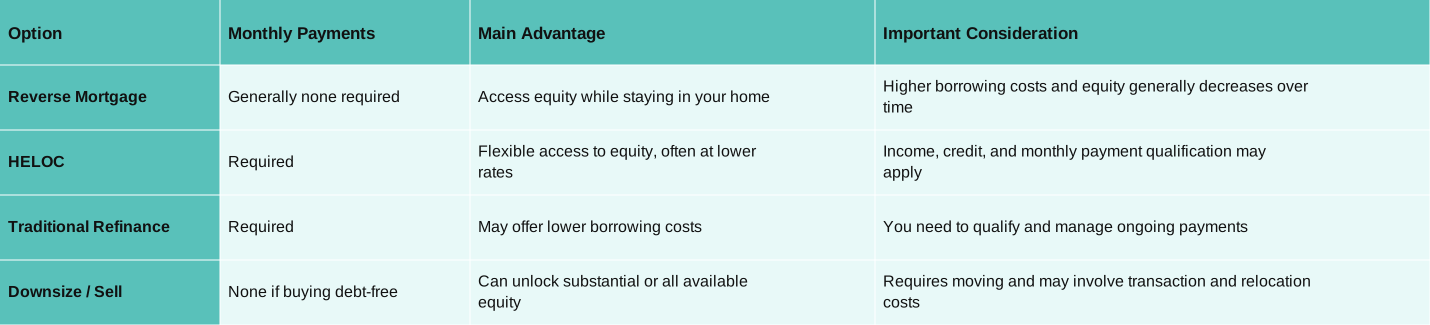
Click on the table above to expand it
Interest Rates & Fees
Reverse mortgage interest rates are generally higher than rates available with conventional mortgages or home equity lines of credit.
Depending on the lender and transaction, costs may include:
- Interest.
- Appraisal fees.
- Legal fees.
- Administrative or setup fees.
- Closing costs.
- Discharge fees.
- Prepayment charges in some situations.
We’ll explain the applicable costs before you decide whether to proceed.
How Reverse Mortgage Interest Works
With a traditional mortgage, you normally make monthly payments that reduce or service the debt.
With a reverse mortgage, regular monthly principal and interest payments are generally not required. Instead, interest is added to the outstanding mortgage balance.
That means the balance can grow over time, and interest may compound on the increasing amount owed.
The longer the reverse mortgage remains outstanding, the more important the total interest cost becomes.
When Does a Reverse Mortgage Need to Be Repaid?
The exact repayment terms depend on your mortgage agreement, but repayment is commonly required when:
- You sell the property.
- You permanently move out.
- The last borrower dies.
- You fail to meet an obligation under the mortgage agreement.
Your lawyer or notary will review the specific repayment conditions before closing.
What Does a Reverse Mortgage Mean for Your Estate?
Because interest accumulates over time, a reverse mortgage generally reduces the amount of home equity that would otherwise remain in the property.
When the last borrower dies, the outstanding balance generally becomes repayable according to the mortgage agreement. The estate may sell the property and use the proceeds to repay the debt.
Heirs may be able to repay or refinance the balance and keep the home, subject to the lender’s requirements and their ability to qualify for financing.
Any remaining equity belongs to the estate after applicable debts and costs are paid. If preserving as much home equity as possible for your heirs is an important goal, that should be part of the conversation before you proceed.
Will a Reverse Mortgage Affect OAS or GIS?
Reverse mortgage advances are borrowed funds rather than employment or investment income.
The borrowed amount itself is generally not taxable and generally does not affect OAS or GIS. However, income earned after investing or otherwise using the funds may affect income-tested benefits.
Speak with a qualified tax or benefits professional about your circumstances.
Is a Reverse Mortgage Right for You?
A reverse mortgage is one way to access home equity, but it isn’t the only option. Depending on your income, credit, current debt, monthly cash flow, home equity, and future plans, another option may make more sense.
These are general comparisons, not personal financial advice. The best option depends on your income, credit, debt, home, goals, and expected timeline.
When Might a Reverse Mortgage Make Sense?
A reverse mortgage may be worth considering if:
- You want to stay in your current home.
- You want access to home equity.
- You want to reduce or eliminate required mortgage payments.
- You have limited retirement cash flow.
- You want to pay off an existing mortgage.
- You don’t want to qualify based primarily on traditional income and debt-service requirements.
When Might an Alternative Be Better?
A HELOC or refinance may make more sense if you have strong income, qualify comfortably, and are willing to make monthly payments.
Downsizing may make more sense if you are already planning to move and want to access more of your home equity without carrying a loan against the property.
There is no single answer that is right for every homeowner
Ready to Explore Your Reverse Mortgage Options?
You do not have to decide today. The first step is simply understanding what may be available, what it could cost, and whether a reverse mortgage makes sense for your situation.
Whether you want to supplement retirement income, pay off your current mortgage, renovate your home, help family, or create more financial flexibility, Cutting Edge Lending can help you understand your options.
Speak With a BC, Alberta, Ontario and Saskatchewan Reverse Mortgage Specialist
Or call (250) 590-6009.
No pressure. No obligation. Clear answers.